
Today, our team opened Slack and the daily agenda was already there. Eight items, prioritized, each one linked to the source it came from. A Slack thread about a client proposal. A Google Doc someone had edited the night before. An open decision in Notion that had been sitting for three days.
Nobody compiled that list. Nobody spent 20 minutes before the meeting pulling tabs together. My cat bot Phil swept everything overnight, read the context, and posted the rundown at 7am. (Yes, I named my AI agent after a cat.)
The meeting had direction before anyone said a word.
What That System Actually Looks Like
The agent pulls from four sources every morning:
Slack channels where the team talks. It reads active threads, pulls out anything that needs a decision or follow-up, and links back to the original conversation.
Google Docs that were created or edited in the last 24 hours. It reads the full content and extracts actionable items.
Huddle transcripts from the previous day's meetings. Unresolved items, follow-ups that got mentioned but not captured anywhere.
A Decisions Database in Notion that tracks open items, blockers, things that still need someone to make a call.
All of it gets synthesized into a single Slack message with grouped categories (client pipeline, sales, internal ops), each with an owner and a clickable link to the source.
The other piece I built in: it's interactive. Agendas are usually static. One person owns it, everyone else shows up and reacts. But when you surface the agenda in a space where people already work (Slack, in our case), and it's that easy to add, edit, or delete items, people actually use it.
Reply in the thread saying "add the pricing review," and the agent adds it. Say "remove item 3," and it's gone. The agenda stays alive all day. By the time we sit down, the pre-work is already baked in.
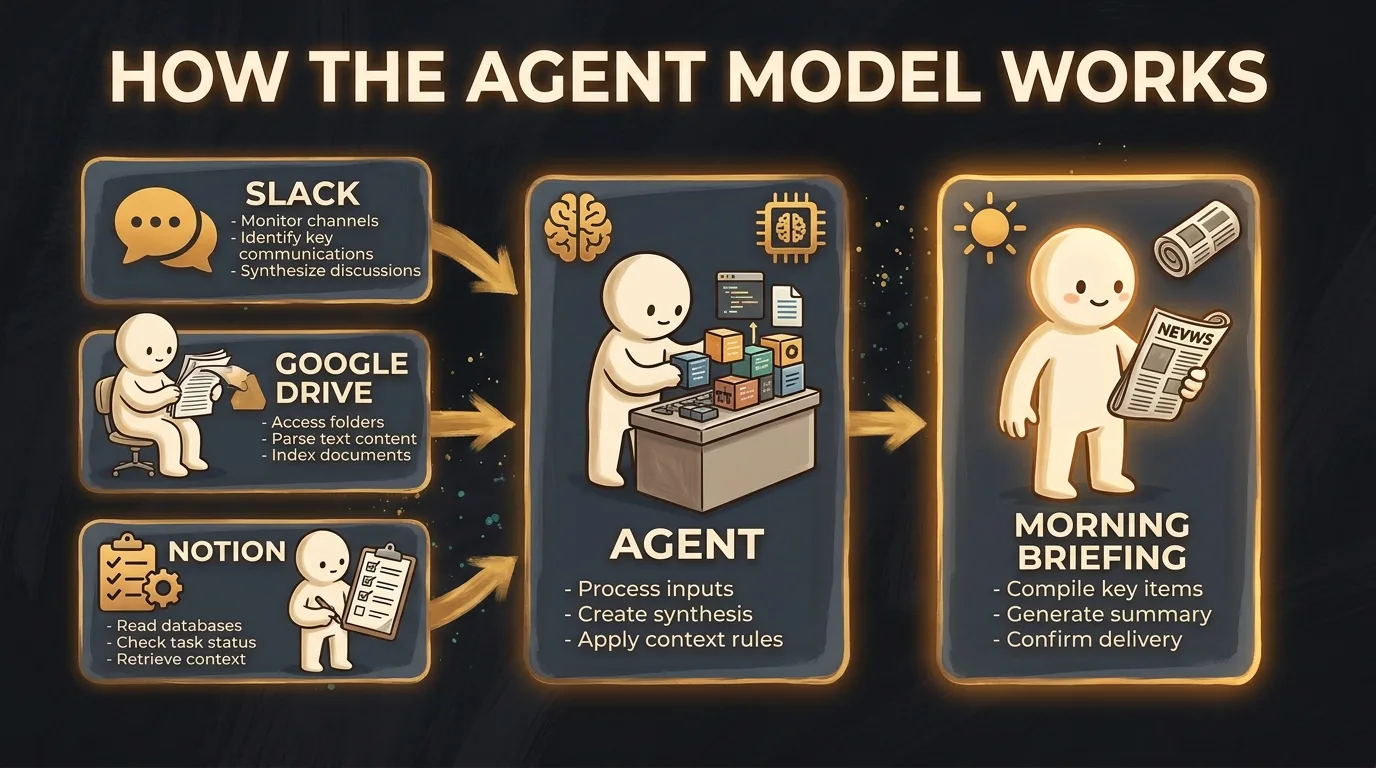
The agent bridged the data. It didn't centralize it.
Three APIs, one agent, one output. That's the whole thing.
The Centralization Lie
Here's the conversation I've had a dozen times. A founder or ops lead says: "We need to get everything into one platform. Notion. Monday. Asana. Pick one, migrate everything, and then we'll finally have visibility."
They spend weeks designing the perfect workspace. They migrate data. They write documentation. They run training sessions.
Six months later, half the team is back in spreadsheets. The CRM has stale records. The project tracker has tasks from Q2 that nobody closed.
This pattern has a number attached to it. CRM implementations fail 55 to 75% of the time, and the primary driver is adoption, not technology. The platform worked fine. The people didn't use it.
Every "let's get everything into one platform" project fails because people don't adopt platforms they weren't already using. You can build the most elegant Notion workspace in the world. If your sales team lives in email and your designers live in Figma and your developers live in Linear, they're not moving. They'll nod in the all-hands. They'll bookmark the link. And then they'll go back to the tool that's already open.
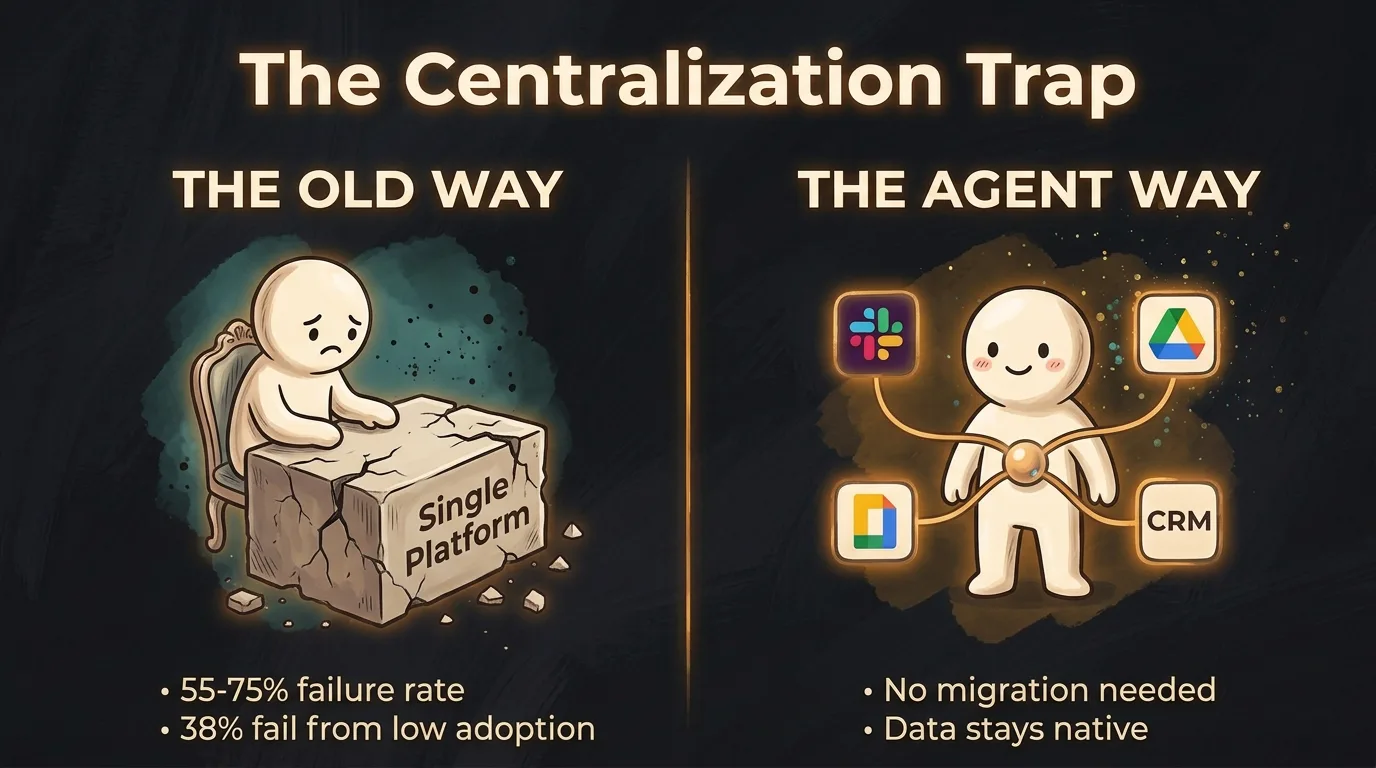
The assumption behind centralization is that fragmentation is the problem. The data was never the problem. The assumption that humans should move it was.
How the Agent Model Works
The agent model starts from a different premise: leave everything where it is and build a reader that can pull from all of it.
Your Slack workspace has an API. Google Drive has an API. Notion has an API. Your CRM has an API. Every tool your team already uses has a programmable surface. An agent can authenticate to each one, read what's relevant, and synthesize it into a single output, without anyone changing a single habit.
The mental model shift is subtle but it changes everything downstream. You stop asking "where should we store this?" and start asking "can an agent read it where it already lives?" The answer is almost always yes.
One caveat, because I don't want to oversell this: agents still need a map. Your data can stay scattered across tools, but within each tool, the agent needs to know where to look. Transcripts go in a specific Drive folder. CRM fields that matter actually get filled. Docs live inside a known workspace.
You're organizing within each tool so the agent can reliably find what it needs. Think of it as organized chaos: the chaos of multiple platforms is fine, as long as each platform has enough internal structure for an agent to navigate it.
The good news is that most teams already have this partially done. You already have a Drive folder for client docs. You already have a Slack channel for each project. The bar is lower than you think.
And here's the compounding insight from building this. Once you wire up one connection (say, the Notion API for the Decisions Database), that connection is live for every future agent you build.
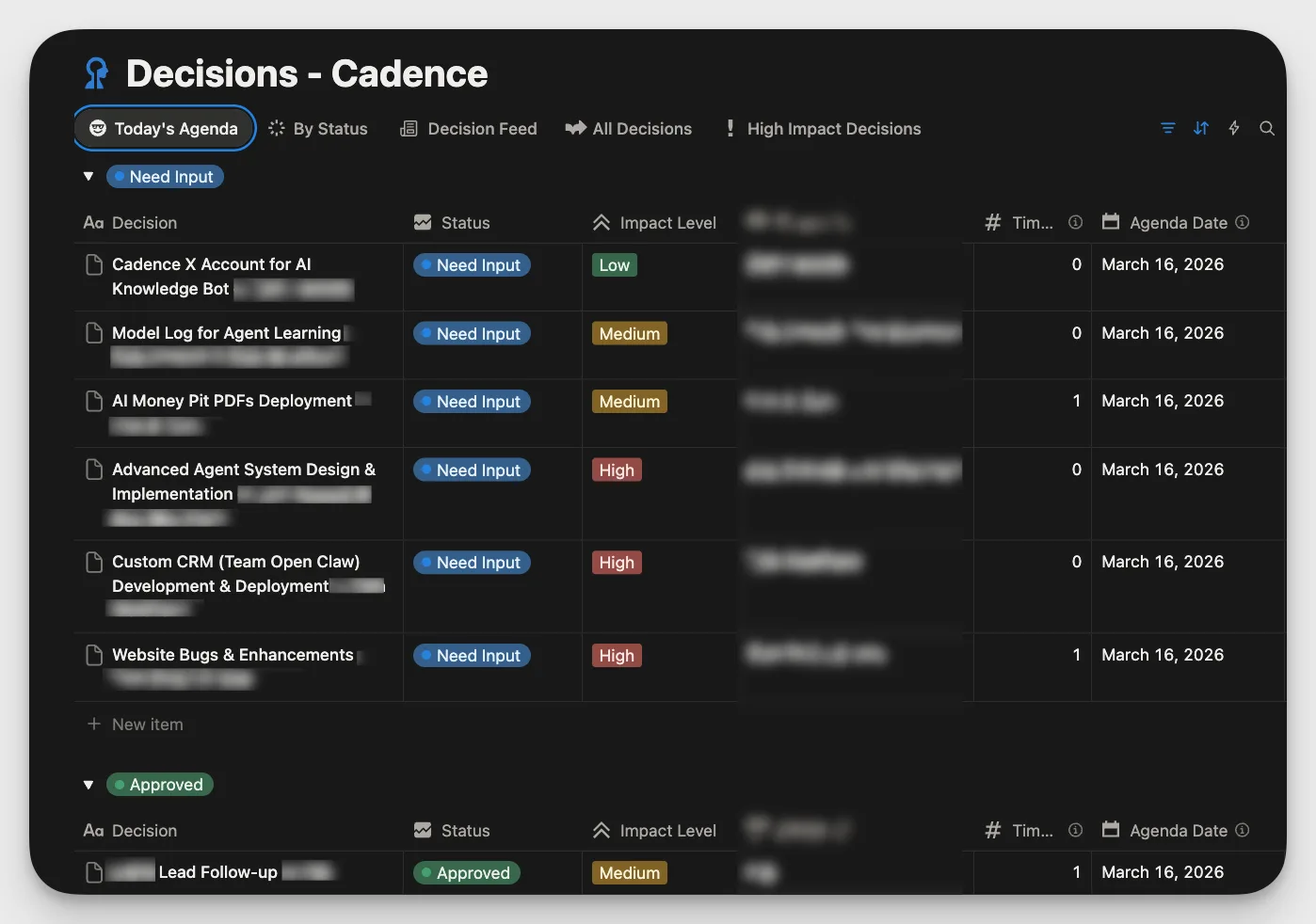
Next time you need Notion data for something else, the infrastructure is already there. Same with Drive. Same with Slack. You build these small connections and then wiring up new agents that pull from multiple sources becomes almost trivial.
Each integration is an investment that pays out across every agent you build after it. The second agent is easier than the first. The fifth is almost free.
This is the "tools change, architecture stays" principle from a previous issue. The specific APIs might evolve. The pattern of building connectors and pointing agents at existing data sources is durable.
What to Point Agents At First
If you're thinking about trying this, here's a sequenced approach. No coding required (though it helps). The goal is to identify the highest-value target before you build anything. (And if you want a reminder of why starting small beats elaborate systems, I've written about that before.)
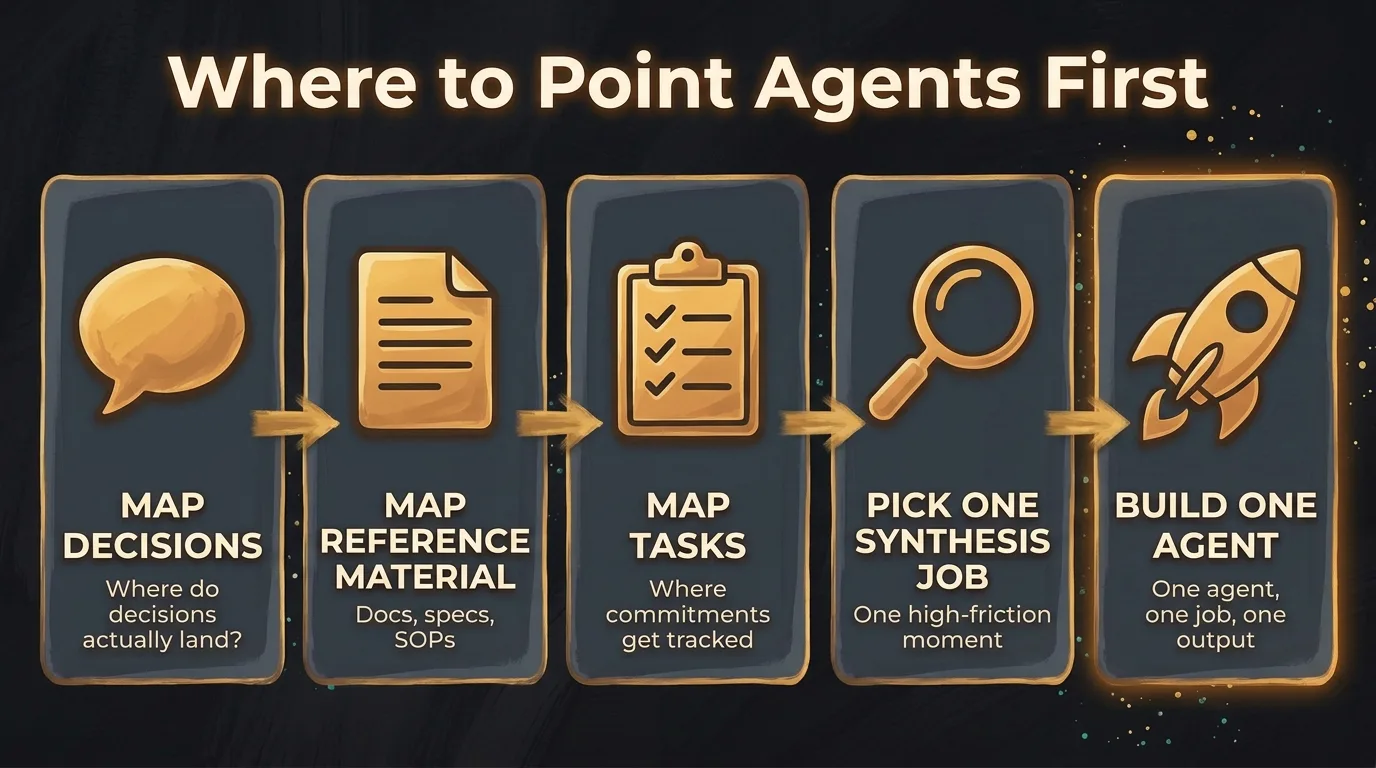
1. Map where your team's information already lives.
Not where it should live. Where it actually lives right now. For most teams, the answer is 3 to 5+ tools. Slack, email, a docs platform, a project tracker, maybe a CRM. Write them down.
2. Identify the manual retrieval loop.
Where does someone on your team spend time pulling information from one tool into another? The person who compiles the weekly report. The manager who checks three dashboards before a meeting. The founder who reads Slack channels every morning to figure out what's going on. That loop is your target.
3. Check for an API.
Most tools your team already uses have one. Slack, Google Workspace, Notion, HubSpot, Salesforce, Linear, Asana, Monday, Jira. If the tool has an API (it probably does), an agent can read from it.
4. Define the output, not the process.
Don't start with "I want to automate Slack." Start with "I want a prioritized list of what needs discussion before our morning meeting." The output shapes the agent. The process is just plumbing.
5. Start with read-only.
Your first agent should read and synthesize. It shouldn't write, send, or modify anything. Reading is low-risk and high-signal. You'll learn fast what's useful and what's noise.
Stop asking where to store everything. Start asking what you can point an agent at.
The Real Payoff
The obvious payoff is time. The daily agenda agent replaced 15 to 20 minutes of manual compilation every morning. Across a team, that adds up fast.
But the less obvious payoff is the one that actually matters: accountability.
Every item on the agenda has a source link. Click it and you're in the Slack thread where it was discussed. Click another and you're in the Google Doc where the language was drafted. The agent creates a trail without anyone doing extra work. No one had to "log" anything. The agent pulled from systems people were already using and assembled the record automatically.
What agents free up is the time that was being spent moving data by hand. The retrieval. The compilation. The "let me check Slack real quick" that turns into 20 minutes of scrolling. All of that goes away when an agent handles the read layer.
Your team keeps working in the tools they're comfortable with. Slack stays Slack. Drive stays Drive. Notion stays Notion. The agent sits underneath all of it, reading what's relevant and surfacing what matters.
The goal was always synthesis.
The silos didn't disappear. They're all still there. They just stopped being a problem.
Keep building, Tam